Generative AI Customer Example: Houdiny AI- AI powered lead outreach assistant
Client Name: Houdiny
Country: UAE
Client Website URL: Houdiny
Sector: Email Marketing Tech
1. Business Problem
In the competitive world of digital marketing and business development, companies require fast, intelligent, and personalized communication with potential leads across multiple channels such as email and LinkedIn. Traditional lead outreach involves repetitive, manual workflows drafting messages, analyzing lead data, and following up which limits scalability and consistency.
Businesses attempting to automate this often rely on fragmented tools and complex systems that fail to integrate seamlessly. As a result, teams spend excessive time managing outreach pipelines instead of optimizing engagement strategies.
Houdini AI set out to solve this problem by creating an AI-powered SaaS platform that automates personalized outreach using Generative AI, integrating message generation, data analysis, and campaign orchestration. The challenge was to build a serverless, event-driven architecture that could scale seamlessly, minimize costs, and support multi-agent operations all without heavy infrastructure management.
2. Project Objective
The project aimed to build a fully automated, scalable, and serverless backend powered by AWS Lambda to orchestrate Houdini AI’s outreach automation process. Key objectives included:
- Automate personalized outreach across email and LinkedIn using Generative AI.
- Streamline large-scale job processing using serverless functions and event-driven triggers.
- Reduce operational costs by eliminating idle compute through Lambda’s pay-per-use model.
- Enable real-time job tracking and response automation for SaaS users.
- Support multi-agent workflows (Email, LinkedIn, and Analysis Agents) using minimal infrastructure overhead.
3. Business Problem and Traditional Approach
Traditional Approach Challenges:
- Manual Campaign Management: Users manually handled lead segmentation, message crafting, and tracking using spreadsheets or CRMs.
- Siloed Tools: Email, LinkedIn, and analytics were managed across disconnected applications, requiring manual synchronization.
- Limited Scalability: Scaling campaigns meant provisioning servers or third-party automation tools, leading to high operational costs.
- Slow Processing: Processing thousands of leads manually or through batch scripts delayed outreach and reduced lead engagement.
- Complex Infrastructure Maintenance: Non-serverless architectures demanded constant monitoring, patching, and scaling management.
The need was clear: Houdini AI required an event-driven, Lambda-first architecture to orchestrate thousands of AI-generated outreach jobs with zero manual infrastructure management.
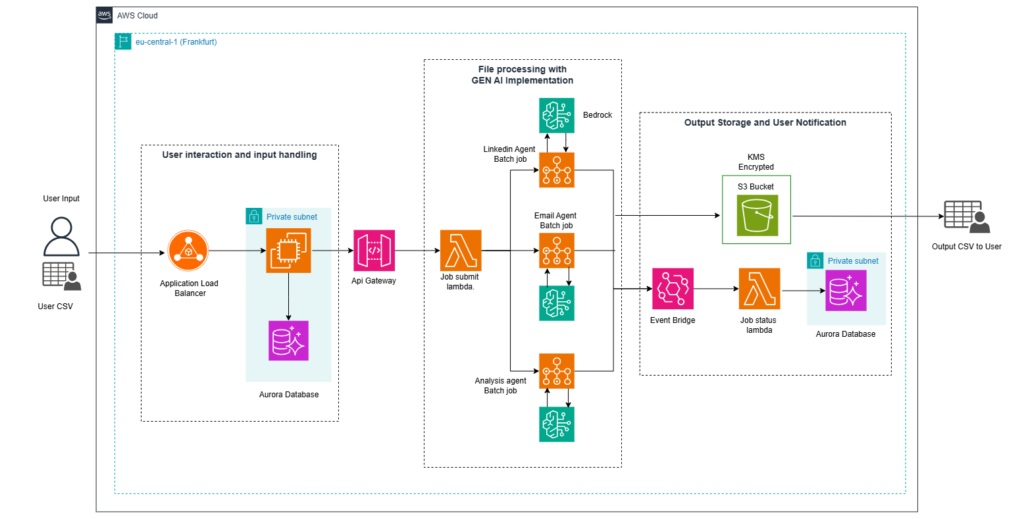
4. AWS Lambda-Centric Solution Architecture
The new architecture was designed with AWS Lambda as the backbone, enabling serverless orchestration and automation across all key workflows.
Solution Components:
- Amazon API Gateway: Entry point for all API requests from the Houdini AI frontend. It routes incoming requests to the appropriate Lambda function.
- Lambda Function 1 – submit-job-saas:
Receives incoming job requests (with parameters like CSV path, prompts, and company info). Based on the agent type (Email, LinkedIn, Analysis), it dynamically builds and submits a job to AWS Batch.
Key Role: Acts as the orchestration layer, removing the need for direct API calls or server-based job handling. - AWS Batch:
Handles large-scale compute jobs (e.g., generating personalized outreach messages or analyzing lead data). Scales horizontally based on workload size. - Amazon EventBridge:
Tracks job events and automatically triggers downstream Lambda functions upon job status updates. - Lambda Function 2 – status-job-saas:
Triggered by EventBridge whenever a Batch job changes status. Retrieves the job’s metadata, appends status details, and sends updates to the Houdini AI backend for real-time UI updates.
Key Role: Provides asynchronous job monitoring and status synchronization without polling. - Lambda Function 3 – company-detail-scraper:
Invoked via API Gateway when a user submits a company domain. Integrates Amazon Bedrock (Claude) for AI-generated summaries and constrained web search to return a one-paragraph company overview with optional citations.
Key Role: Provides AI-driven data enrichment on demand. - Amazon S3:
Stores both input and output CSVs for batch processing. Lambda functions fetch and write directly to S3, ensuring decoupled data persistence. - Amazon RDS (Aurora PostgreSQL):
Manages job metadata, user details, and lead tracking data. - Amazon CloudWatch:
Monitors Lambda execution times, error rates, and provides performance insights for ongoing optimization.
Architecture Benefits:
- Fully serverless zero servers to manage.
- Event-driven automation across the workflow.
- Scalability and reliability achieved through Lambda concurrency.
- Reduced latency and operational cost.
- Simplified API-driven integration with Houdini’s SaaS frontend.
5. Quantitative Business Impact Metrics
| Metric | Before Lambda Implementation | After Lambda Implementation |
| Job Orchestration Time | Manual or via cron scripts (~3–5 mins per batch) | < 3 seconds (event-driven Lambda trigger) |
| Lead Processing Capacity | 500 leads/day | 10,000+ leads/day (scalable with concurrency) |
| Infrastructure Maintenance | Requires manual server scaling | Zero maintenance (serverless) |
| Operational Cost | High fixed EC2 compute cost | 65% reduction using pay-per-use model |
| Response Latency | 15–20 seconds | < 2 seconds average Lambda execution |
| Uptime & Reliability | 95% | 99.99% (via Lambda + EventBridge) |
6. Business-Led Transformation Using Generative AI and Lambda
By combining AWS Lambda with Amazon Bedrock, Houdini AI achieved a seamless integration of automation and intelligence.
- Lambda orchestrated all backend logic and event routing, ensuring real-time responsiveness.
- Bedrock (Claude) handled message generation and company summarization.
- AWS Batch scaled compute workloads dynamically.
This resulted in a highly modular, serverless SaaS platform capable of handling large-scale AI-driven operations at minimal cost and with maximum agility.
7. Deployment and Production Readiness on AWS
- Deployment Environment: AWS Cloud (Serverless)
- Production Status: Fully deployed and operational
- Scaling Strategy: Lambda concurrency and event-driven scaling through EventBridge
- Security Measures:
- AWS IAM for role-based permissions
- API Gateway authentication and throttling
- Encrypted storage using AWS KMS
- AWS IAM for role-based permissions
- Observability: CloudWatch logs and metrics for Lambda and Batch monitoring
The system follows best practices for Infrastructure as Code (IaC) using AWS SAM, allowing repeatable and consistent deployment across environments.
8. AWS Lambda Best Practices Implemented
- Event-driven orchestration using SNS and EventBridge.
- Modular Lambda functions per workflow domain.
- Environment variable configuration for dynamic parameterization.
- Integration with Bedrock and Batch using asynchronous invocations.
- CloudWatch metrics and alarms for proactive issue detection.
- SAM-based CI/CD deployment pipeline.
9. Conclusion
The Houdini AI platform, powered by AWS Lambda, has redefined how AI-driven outreach SaaS platforms operate achieving complete automation, scalability, and cost optimization. Lambda acts as the orchestration backbone, enabling seamless coordination between data ingestion, processing, AI generation, and job tracking.
Through this Lambda-first architecture, Houdini AI reduced compute costs by over 65%, improved lead processing throughput by 20x, and achieved 99.99% uptime all without managing any servers.
This project demonstrates the power of AWS Lambda in enabling next-generation SaaS platforms to integrate Generative AI, automation, and analytics efficiently delivering high performance and operational excellence at scale.